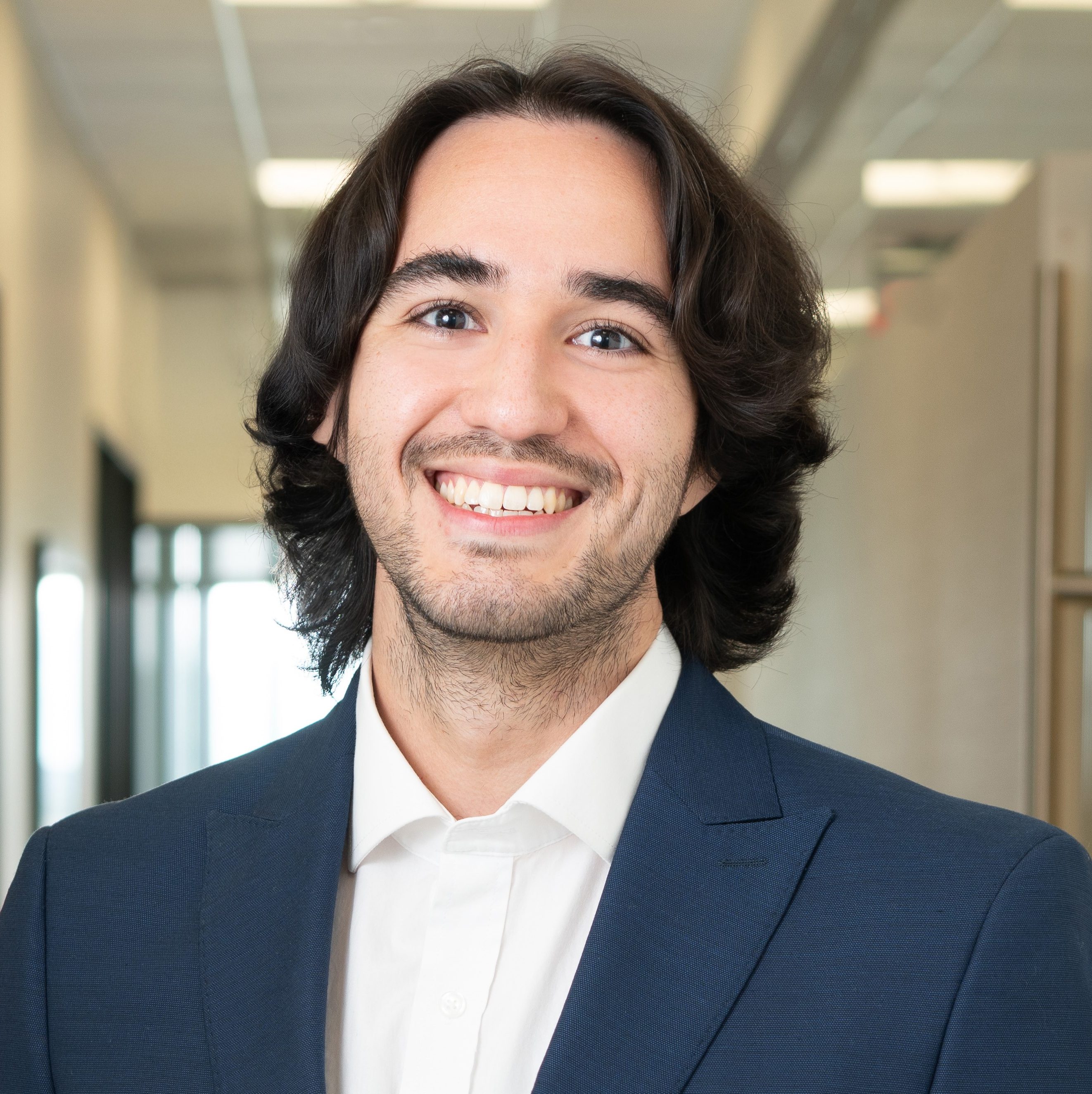
Sebastian Tapia
Economist and consultant specializing in antitrust, litigation support, and data-driven analysis. I help legal teams and policymakers translate complex data into actions.
Education
B.Sc. in Economic and Administrative Sciences
University Diego Portales, Chile, 2019

M.Sc. in Economics
University Adolfo Ibañez, Chile, 2022

M.Sc. in Economics
University of Wisconsin Madison, USA, 2024

Professional Experience
Staff Economist, 2025 – Present
- Support litigation teams in antitrust, contract, and IP cases by conducting data-driven analyses of competitive behavior, pricing, and damages.
- Leverage statistical and econometric methods to prepare large datasets and provide clear, actionable insights.
- Collaborate with other consulting firms and attorneys to strengthen case strategy and evidence presentation.
Key Project: Class Action Litigation, Feb/2025 – present- Manage all datasets related to a main defendant, becoming the primary expert on data management and analysis.
- Lead workflow coordination, data cleaning, merging, and variable manipulation and construction in Stata and R to support analytical and strategic objectives.
- Audit data during and post-discovery, draft memos, presentations, and coordinate with internal teams and external legal consultants.
- Contributed to expert report due November 2025, indicating significant damages likely to lead to settlement or trial.
Economic Consultant, 2022 – 2023
Consultant in antitrust, regulation, auctions, strategic design and other issues in industrial organization; both for private and public institutions.
- Consultant in antitrust, regulation, auctions, strategic design and industrial organization topics; using data analysis tools to evaluate market dynamics and economic trends for clients.
- Created reports and met with clients who were often unfamiliar with economic terminology; collaborated closely with my team to solve relevant problems in a timely manner, ensuring that client needs were met efficiently. Clients included the Court of Defense of Free Competition in Chile, the Electronic Stock Exchange of Chile (BEC), and the National Economic Prosecutor.
- Collaborated with colleagues under an accelerated timeline to design a tender process for the sale of recyclables, rationalize the price system of pharmaceuticals, and design pricing strategies among other projects.
Key Project: Tender Procurement Auction System and Design (ReSimple), Aug/2022 – May/2023- Designed and implemented a new tender procurement process for the sale of packaging waste and recyclable materials under Chile’s recycling laws REP and PUSU.
- Conducted theoretical and applied economic analysis using firm and government data to test model viability and sustainability.
- Produced simulations, memos, and led presentations for government officials and lawyers, communicating results to a multidisciplinary audience
Academic Roles
(U): Undergraduate (G): Postgraduate (GE): Master’s in Economics
University of Wisconsin – Madison
- Teaching Assistant, 2023 – 2024
- 701/2 Microeconomics I (GE), 2024
- 101 Microeconomics (U), 2023 – 2024
Universidad Adolfo Ibáñez
- Lecturer for the Master’s in Industrial Engineering and Operations, Fall 2023
- Econ 453 – Applied Microeconomics (G)
- Teaching Assistant, 2020 – 2023
- Microeconomics II (GE), 2021 & 2022
- Microeconomics I (GE), 2021
- Microeconomic Theory I (U), 2021
- Industrial Organization (U), 2020 – 2023
Universidad Diego Portales
- Teaching Assistant, 2019 & 2021
- Econometrics I (U), 2021
- Industrial Organization (U), 2019
Research & Academic Projects
Consulting & Litigation Support
- Conduct economic and statistical analyses for antitrust, class action, and state-level litigation, including damages measurement (lost profits, royalties, unjust enrichment) in contexts such as patent infringement and loyalty programs.
- Clean, manage, and optimize large-scale datasets in Stata and R, applying econometric methods to ensure accuracy, efficiency, and reproducibility of litigation analyses.
- Draft and revise reports for attorneys, participate in meet-and-confers, and collaborate with legal teams and expert witnesses to align technical work with case strategy and effectively communicate findings.
Academic Research & Projects
Analyzing Entry Dynamics and Strategic Interactions in Retail Markets in R, 2024
More Information
- Explored Probit and ordered Probit models to analyze firm entry, investigate instrumenting strategies for addressing endogeneity, and apply advanced econometric techniques (e.g., Bajari et al.’s two-step method) to model strategic entry games, enhancing understanding of competitive dynamics in retail industries.
- Using R, I cleaned and order the data to estimate Probit regressions of entry decisions on market characteristics, estimate ordered Probit models for market structure, and implement a two-step method for modeling strategic entry games using profit functions, integrating firm-market characteristics and strategic interactions.
- Additionally, I analyzed airline entry decisions with Berry’s (1992) framework; estimating Probit models of entry decisions, ordered Probit models of market structure, and simulate market outcomes using maximum likelihood and simulated method of moments techniques, incorporating observed and unobserved heterogeneity.
Master’s Thesis – (Un)Skilled and Aware of It: Reducing Noise for the Sender, 2022
More Information
- How does the introduction of “skill” in a strategic information transmission model with noise improve welfare outcomes and highlight the link between noise reduction and receiver beliefs about message reliability.
- Developed a theoretical model by extending the strategic information transmission framework, mathematically proving propositions, and creating algorithms to explore how outcomes vary with different variables and parameters. This work highlights the value of theory in building a foundation for future empirical testing, requiring careful analysis and a strong understanding of the underlying economic concepts.
Abstract
We investigate strategic information transmission with observation noise, but include a variable that aids in reducing this noise, which we call skill. Our main findings are that skill improves welfare for the receiver when noise is present in the model; and that welfare in the one-partition equilibrium is greater in the skill model than in both the models with and without noise present. With skill present the uninformative optimal action is skewed towards the side of the true state; it can be seen as the receiver believing that even an uninformative message has a level of truth or skill attached to it. Furthermore, the assumptions we make for simplification have significant ramifications for our results, thus leading us to believe that skill has a greater affect on the model than our assumptions and results would lead us to believe.
Simulating Market Outcomes with (Mixed) Logit Models in the Cereal Industry in R and MATLAB, 2024
More Information
- Estimated BLP by introducing demand and supply estimation in differentiated goods markets using structural models, equipping researchers to evaluate merger effects and market dynamics.
- In R and Python, we clean and order the data to estimate Logit and Mixed Logit models, calculate pre- and post-merger market equilibria, analyze markups and marginal costs, and simulate the effects of mergers on prices and quantities.
Applied Econometrics: Mastery of Stata and Advanced Techniques in Stata, 2020
More Information
- Obtained experience with a broad range of econometric tools essential for causal inference, panel data analysis, and probability modeling
- Demonstrated proficiency in Stata (replicable in R) by implementing methods like OLS, fixed effects, instrumental variables, and discrete choice models, with a focus on robust application and interpretation.
Modeling the Economic Impact of Virus Spread and Policy Interventions in MATLAB, 2020
More Information
- Studied the interplay between public health measures, household and firm economic decisions, and their combined effects on both disease propagation and economic outcomes, offering insights into policy trade-offs.
- Using MATLAB with Dynare, we study a neoclassical model with disease propagation, incorporating wage rigidities, analyzing responses to infection shocks and quarantine policies, and comparing models with and without propagation externalities.
- Additionally, we extended and modified the model to simulate fiscal policy (spending, taxes, debt), monetary policy (interest rate rules), and financial accelerator effects; analyze impacts of health shocks, quarantine measures, and combined fiscal-monetary interventions on key economic variables.
Resources
Compilation of lecture notes and discussion materials from my years as a TA and lecturer across various universities, available in either English and Spanish.
- Ind. Org (U) notes
- Microeconomics II (GE) discussions and evaluations
- Applied Microeconomics (G) lecture slides, problem sets, and exams.
- 701 Microeconomics (GE) discussions.
Technical Skills
Programs
- Advanced: Stata, LaTeX
- Intermediate: R, Excel
- Proficient: MATLAB
- Learning: Python
Econometrics & Statistical Methods
- Ordinary Least Squares (OLS)
- Instrumental Variables (IV)
- Panel Data Techniques
- Demand Estimation
- Probit Models
Data Management, Cleaning, & Reporting
- Cleaning, preparing, and optimizing large-scale datasets in Stata and R
- Data visualization and reporting with Stata, R (ggplot2), and Excel
- Constructing variables and managing merges/reshaping
- Applying quality checks for consistency and accuracy in litigation datasets
- Automating repetitive processes with Stata do-files and R scripts







 Sebastian Tapia